

Steve Edwards, crew, UTC 21.00 UTC 9 Sept Franklin Strait
An interested watch starting at 04:00 this morning (my watches always do start at 04:00 and 16:00). We had stiff winds just off the port (left) bow (front) and both the main sail and genoa sail up. The large sail at the front (the genoa) makes the boat hard to steer in these conditions so that it is hard to stop the boat turning towards the wind. This is a very important safety feature and means that if there is a risk of the boat being capsized by strong winds on the sail the boat turns towards the wind to reduced the pressure on the sail and prevent the capsize. Rudders on boats bigger than dinghies (which are allowed to capsize) are designed to be too small to stop this happening.
Because of this the auto helm was having trouble stopping the boat turning into wind by about 40 degrees, but when it did the strange magnetic fields here meant that the electronic compass showed that the boat was actually rotating and this was shown on the chart plotter screen by the wheel. My first attempt at dealing with this, taking manual control, simply served to reinforce how hard even basic steering is in this environment. It was almost completely dark in fog with abut 100yds visibility so without a useful compass the only way I had of telling which way the boat was facing was the GPS course over the ground, which tends to be 10 seconds behind the reality and so not much use when you are being blown round by the wind and all the sail. The auto helm has gyros and accelerometers which should tell it what is going on immediately but of course I could not see any of this information.
I struggled with this for about 5 mins doing pretty badly, although slightly better then the auto helm, leaving a track like a drunk on the chart plotter, before deciding that this was definitely not the answer. I then realised that we would be better with much less sail and the genoa is both the easiest to get in short handed and the one which causes most of the trouble. Fortunately with this furled (rolled up) the boat became much easier to steer and when I had it pointing in the right direction and engaged the auto helm then all was well. A couple of interesting lessons here though – including the value of a GPS based synthetic compass in the NW passage.
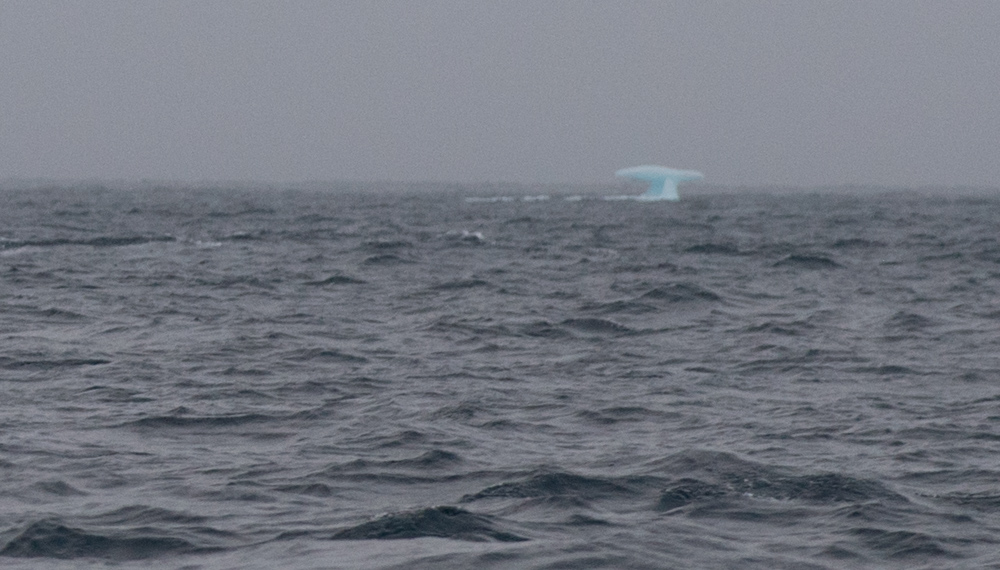
A couple of hours later I saw our first ice since leaving Barrow. This was at about 69d 30m North and 99d West and exactly where yesterday’s ice charts said we might see a little ice. The pictures are with a telephoto lanes and are much enlarged as they were several hundred yards away as were the 4 other pieces we saw today. Since then we have moved East away from the ice and all is clear, which is a relief as we go into night.
Steve


1 Comment. Leave new
Thanks for “translating” the nautical terms! I’m following this voyage with great interest from the Midwestern U.S., but I’m not a sailor!